👉🏻 이 부분은 미니OS 텍스트 모드 시작 부분입니다.
This section marks the beginning of the MiniOS text mode.
👉🏻 32비트 보호 모드 진입 및 C언어 kernel_maiin()함수로드 까지 입니다.
This covers the transition into 32-bit protected mode and the loading of the C-language kernel_main() function.
👉🏻32비트 보호 모드에서는 램을 4기가까지 사용할 수 있습니다.
In 32-bit protected mode, up to 4 GB of RAM can be used.
📁boot.asm
✔️ 디스크읽기 / Disk read
    mov ah, 0x02        ; 디스크 읽기 기능 / Disk reading capability
    mov al, 12          ; 읽어올 섹터 개수(12개) / Number of sectors to read (12)
    mov ch, 0           ; 실린더 0 / Cylinder 0
    mov cl, 2           ; 시작 섹터 2 / Starting sector 2
    mov dh, 0           ; 헤드 0 / Head 0
    mov bx, 0x8000      ; 메모리 0x8000에 로드 / Loaded into memory 0x8000
    int 0x13
1)실제로 플로피 디스크를 읽어 보는 부분입이다.
This is the part where the floppy disk is actually read.
✔️ sector2.asm으로 점프해서 코드 실행
Jump to sector2.asm and execute the code
jmp 0x0000:0x8000✔️ 부트 시그니처
Boot signature
; 1번 섹터(MBR) 빈 공간을 0으로 채우고 부트 시그니처 추가
; Fill remaining space of sector 1 (MBR) with 0 and add boot signature
times 510 - ($ - $$) db 0
dw 0xaa55
1)이 코드가 없으면 부팅할 수 없음 / Without this code, it cannot boot.
📁 sector2.asm
✔️ sector2.asm이 0x8000 이 주소에서 실행될 수 있는 이유는 boot.asm에서 점프하고 컴파일시 링커옵션을 통해서 주소를 지정했기 때문입니다.
The reason sector2.asm can execute at the address 0x8000 is that the code jumps there from boot.asm, and the address was specified using linker options during compilation.
# 1. boot.asm의 점프 코드 / Jump code in boot.asm
jmp 0x0000:0x8000

# 2.컴파일시 단일 바이너리로 결합시 옵션으로 주소를 지정
#   Specify addresses as an option when combining into a single binary during compilation.
i686-elf-ld -m elf_i386 -Ttext 0x8000 -e start sector2.o kernel.o -o kernel.bin --oformat binary
1) -e start는 sector2.asm의 global start 위치를 의미함.
-e start refers to the global start location in sector2.asm.
✔️ A20 게이트 활성화 (메모리 1MB 이상 접근 허용)
A20 gate activation (enables access to memory beyond 1MB)
    in al, 0x92
    or al, 2
    out 0x92, al
1) in al, 0x92 :
마더보드의 시스템 제어 포트 중 하나인 0x92번 포트(System Control Port A)의 현재 하드웨어 상태 값을 읽어와서 al 레지스터에 저장
Read the current hardware status value of port 0x92 (System Control Port A)—one of the motherboard’s system control ports—and store it in the AL register.
2)or al, 2:
al 레지스터에 들어 있는 값과 숫자 2(이진수로 00000010)를 비트 OR 연산
Perform a bitwise OR operation between the value in the al register and the number 2 (00000010 in binary).
0x92 포트의 2번 비트가 바로 A20 게이트를 켜고 끄는 스위치 역할을 함.
Bit 2 of port 0x92 acts as a switch for enabling and disabling the A20 gate.
or al, 2를 수행하면 기존에 어떤 값이 들어 있었든 상관없이 다른 비트는 그대로 유지한 채 2번 비트만 무조건 1(참)로 바뀌게 됨.
Performing an OR operation with 2 will force the 2nd bit to become 1 (true), regardless of its previous value, while leaving all other bits unchanged.
3)out 0x92, al
2번 비트가 1로 조작된 al 레지스터의 값을 다시 0x92번 포트에 출력(저장)
Output (store) the value of the AL register—with its 2nd bit set to 1—back to port 0x92.
이 명령어가 실행되는 순간 마더보드의 하드웨어 회로가 반응하여 A20 라인(주소선)이 강제로 열리게 됨.
The moment this instruction is executed, the motherboard’s hardware circuitry responds, forcing the A20 line (address line) to open.
✔️ GDT 로드
Loading the GDT
lgdt [gdt_pointer]1)lgdt [gdt_pointer] (Load Global Descriptor Table)
메모리 접근 규칙과 권한을 정의해 둔 GDT(Global Descriptor Table)의 위치와 크기 정보를 CPU에게 알려주고 등록하는 명령어입니다.
This is an instruction that informs the CPU of the location and size of the Global Descriptor Table (GDT)—which defines memory access rules and permissions—and registers it.
16비트 모드에서는 단순히 세그먼트 × 16 + 오프셋 계산으로 실제 물리 메모리(RAM)에 직접 접근 방식을 사용했습니다. 이 방식은 메모리에 대한 보호체계가 없고 운영체제 영역이든 아무곳에나 메모릴 사용 할 수 있어서 시스템이 다운될 수 있습니다.
n 16-bit mode, a method was used to access actual physical memory (RAM) directly by simply calculating “segment × 16 + offset.”
This approach lacks a memory protection mechanism, allowing memory to be accessed anywhere—including within the operating system’s own space—which can cause the system to crash.
32비트 보호모드에서는 철저한 규칙과 검사체계를 도입함으로 CPU가 메모리를 사용시 매번 엄격하게 검사합니다.
In 32-bit protected mode, a system of rigorous rules and checks is implemented, ensuring that every instance of CPU memory access is strictly verified.
✔️ GDT 테이블 / GDT Table
; GDT(Global Descriptor Table) 정의
; Definition of Global Descriptor Table (GDT)
align 4
gdt_start:
    dd 0, 0                     ; 1. 널 디스크립터 / Null descriptor
    dw 0xFFFF, 0x0000           ; 2. 코드 세그먼트 (0x08) / Code segment (0x08)
    db 0x00, 0x9A, 0xCF, 0x00
    dw 0xFFFF, 0x0000           ; 3. 데이터 세그먼트 (0x10) / Data Segment (0x10)
    db 0x00, 0x92, 0xCF, 0x00
gdt_end:

gdt_pointer:
    dw gdt_end - gdt_start - 1
    dd gdt_start
1)메모리 주소 배치 / Memory address layout
메모리 주소가 4로 나누어 떨어지는 위치에 GDT주소 배치(데이터를 읽을때 4바이트 단위로 읽음)
CPU가 메모리를 효율적이고 빠르게 읽게 하기 위한 주소배치
Place the GDT address at a memory location that is a multiple of 4 (since data is read in 4-byte units).
Address arrangement to enable the CPU to read memory efficiently and quickly
align 42)널 디스크립터 / Null descriptor
GDT의 맨 첫 번째 칸(인덱스 0번)은 반드시 0으로 채워진 빈 칸(Null)이어야 한다는 CPU 기준
CPU specification requiring the very first entry (index 0) of the GDT to be a null entry (filled with zeros).
dd 0, 0 3)코드 세그먼트 (총 8바이트) — 아래 두 줄이 합쳐져서 1개 세그먼트
Code segment (8 bytes total) — the two lines below combine to form a single segment
— 0xFFFF = 65535 ,컴퓨터가 실행할 명령어(코드)가 담긴 영역의 규칙을 정의
Define the rules for the area containing the instructions (code) that a computer will execute.
— dw(Define word) 2바이트(16비트) 크기의 데이터를 메모리에 할당
Allocate 2 bytes (16 bits) of data in memory
— db(Define byte) 1바이트(8비트) 크기의 데이터를 메모리에 할당
Allocate 1 byte (8 bits) of data in memory
dw 0xFFFF, 0x0000           ; 앞 4바이트 (메모리 크기 및 시작 주소 일부)
                            ; First 4 bytes (memory size and part of the start address)
db 0x00, 0x9A, 0xCF, 0x00   ; 뒤 4바이트 (권한 속성 및 나머지 주소)
                            ; Last 4 bytes (permission attributes and remaining address)
4)데이터 세그먼트 (총 8바이트) — 아래 두 줄이 합쳐져서 또 다른 1개 세그먼트
Data segment (8 bytes total) — the two lines below combine to form another single segment
— 앞 4바이트는 같고 뒤 4바이트중 0x92 이것만 다름.
The first 4 bytes are the same, and among the last 4 bytes, only the 0x92 value differs.
dw 0xFFFF, 0x0000           ; 앞 4바이트 (메모리 크기 및 시작 주소 일부)
                            ; ; First 4 bytes (memory size and part of the start address)
db 0x00, 0x92, 0xCF, 0x00   ; 뒤 4바이트 (권한 속성 및 나머지 주소)
                            ; Last 4 bytes (permission attributes and remaining address)
💡
코드 세그먼트 : 기계어 코드 저장구역(어셈블러 + C언어)
Code segment: A storage area for machine code (assembler + C language)
데이터 세그먼트(스택 세그먼트) : 변수저장구역
Data segment (stack segment): Storage area for variables5)gdt_pointer
— GDT테이블이 위치하는 메모리 주소의 시작과 끝을 기록함.
Records the start and end memory addresses where the GDT table is located.
— dd(Define Doubleword) 4바이트(32비트) 크기의 데이터(정수나 메모리 주소)를 메모리에 할당
Allocate 4-byte (32-bit) data (integers or memory addresses) in memory
gdt_pointer:
    dw gdt_end - gdt_start - 1
    dd gdt_start
1)gdt_end,gdt_start와 같은 라벨을 만들면 라벨에 현재 메모리 위치 값이 저장됨
Creating labels such as gdt_end and gdt_start causes the current memory location value to be stored in those labels.
2)dw gdt_end – gdt_start – 1 이유는 주소가 1번이 아닌 0번 부터 시작하기 떄문에 -1을 해주어야 정확한 주소 확인이 가능함
The reason for dw gdt_end - gdt_start - 1 is that addresses begin at 0 rather than 1; therefore, subtracting 1 is necessary to obtain the correct address.
# 정확한 주소가 아님 / Not an accurate address
(0x8000 + gtd_end) - (gdt_start) = 24

# 정확한 주소 / Exact address
(0x8000 + gtd_end) - (gdt_start) - 1 = 23
💡
sector2.asm은 메모리의 0x8000번지 입니다.(링커에서 지정함.)
sector2.asm is located at memory address 0x8000 (as specified in the linker).
이때 GDT테이블은 위의 주소부터 차례대로 숫자 데이터를 메모리에 기록합니다.
At this point, the GDT table records numerical data into memory, starting from the aforementioned address and proceeding sequentially.
기록순서는 다음과 같습니다.
The order of the records is as follows.
널디스크립터,코드세그먼트,데이터세그먼트 gdt_pointer의 dw,dd부분
The `dw` and `dd` components of the `gdt_pointer` for the null descriptor, code segment, and data segment.
✔️32 비트 보호 모드 진입 / Entering 32-bit protected mode
jmp 0x08:protected_start✔️C언어실행 / Executing C code
— C언어 함수를 어셈블러로 가져오기 / Importing C Functions into Assembly
extern kernel_main — 불러온 C언어 함수 실행 / Execute the imported C function
call kernel_main✔️ 데이터 세그먼트 레지스터 초기화 / Initialization of data segment registers
    mov ax, 0x10
    mov ds, ax
    mov es, ax
    mov fs, ax
    mov gs, ax
    mov ss, ax
1)GDT테이블의 데이터 세그먼트를 사용하기 위해서 레지스터 초기화 0x10(=16)
Initializing registers to use data segments from the GDT table
2)코드 세그먼트는 0x08
The code segment is 0x08
✔️ 32비트 CPU의 스택 포인터 레지스터(esp)에 메모리 주소 0x90000을 대입
Assign memory address 0x90000 to the stack pointer register (esp) of a 32-bit CPU
mov esp, 0x900001)앞으로 프로그램(특히 C언어 커널)이 사용할 스택(Stack)의 위치를 지정
Specifies the location of the stack that the program (especially the C language kernel) will use in the future.
2)스택의 주소를 0x90000로 지정해서 커널 코드가 있는 0x8000와 겹치지 않고 사용가능
By setting the stack address to 0x90000, it can be used without overlapping with the 0x8000 address where the kernel code resides.
3)C언어를 사용하려면 반드시 스택공간을 설정해야함
To use the C language, you must configure stack space.
📁kernel.c
✔️ 비디오 메모리 주소 지정 / Video Memory Addressing (0xB8000)
volatile char *vram = (volatile char *)0xB8000;1)VGA 텍스트 모드 비디오 메모리 주소
VGA text mode video memory address
0xB80002)volatile
외부 요인(하드웨어 등)에 의해 값이 변할 수 있으니 매번 진짜 메모리에 직접 접근 하도록하는 최적화 방지 경고
A warning to prevent optimization, ensuring that the value is accessed directly from actual memory every time, as it may be altered by external factors (such as hardware).
프로그램 바깥의 하드웨어와 직접 소통하는 모든 메모리 공간에 필수적으로 사용
Essentially used in all memory spaces that communicate directly with hardware outside the program
✔️ 화면에 글자 출력
Display text on the screen
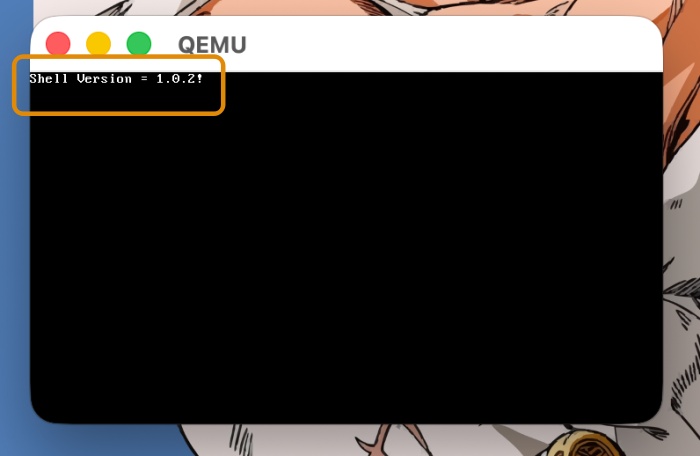
    const char *msg = "Shell Version = 1.0.2!";
    int i = 0;

    while (msg[i] != '\0') {
        vram[i * 2]     = msg[i];       // 짝수 바이트: ASCII 문자 / Even-numbered bytes: ASCII characters
        vram[i * 2 + 1] = 0x0F;         // 홀수 바이트: 흰색 글자, 검은 배경 속성 / Odd-numbered bytes: white text, black background attribute
        i++;
    }
1)*msg는 문자열 포인터이지만 C언어에서 배열과 동일하게 사용가능(내부적으로 동일하게 동작함)
*Although msg is a string pointer, it can be used in the same way as an array in C (it functions identically under the hood).
2)비디오 메모리 하드웨어 메모리 구조에서 짝수 번지에는 글자,홀수번지에는 색상 속성을 저장함.
In the video memory hardware architecture, even-numbered addresses store characters, while odd-numbered addresses store color attributes.
        vram[i * 2] = msg[i];
        vram[i * 2 + 1] = 0x0F;
3)VGA텍스트 모드의 기본설정은 검은 바탕에 흰색 글자
The default setting for VGA Text Mode is white text on a black background.
📁 테스트 / Test
✔️ 컴파일
% rm -f *.bin *.o *.img temp.bin sector2.bin
nasm -f bin boot.asm -o boot.bin
nasm -f elf32 sector2.asm -o sector2.o
i686-elf-gcc -m32 -c kernel.c -o kernel.o -nostdlib -fno-builtin -fno-stack-protector -fno-pic -fno-PIE
i686-elf-ld -m elf_i386 -Ttext 0x8000 -e start -o sector2.bin sector2.o kernel.o --oformat binary
cat boot.bin sector2.bin > temp.bin
dd if=temp.bin of=os.img bs=512 count=2880 conv=sync
qemu-system-x86_64 -drive file=os.img,format=raw,if=floppy -boot a
✔️ 스크린 샷 / ScreenShot
마태복음 21장 22절 / Matthew 21: 22
“너희가 기도할 때에 무엇이든지 믿고 구하는 것은 다 받으리라 하시니라”
“And everything you ask in prayer, believing, you will receive.”


